
NWFA Certified Process
The Real Science of Hardwood Floor Acclimation
Wood is a living, breathing material. Discover how we use digital moisture testing and HVAC science to ensure your floor survives Michigan's extreme seasonal changes.
Industry Misconception
Shattering the Acclimation Myth: It's Not About the Clock.
One of the biggest misconceptions in flooring is that acclimation is strictly a time-related process. Some contractors just drop wood in a room for three days and assume it's ready. While you can occasionally get lucky and have wood delivered that already matches your home's environment, true acclimation is entirely about adjusting the wood's internal moisture to match its new ecosystem. It is a science of measurement, not a calendar. Century-old reclaimed material carries a fundamentally different moisture history than kiln-dried new hardwood, and requires an extended acclimation window that most contractors underestimate.
Moisture Science
Testing for Perfect Equilibrium.
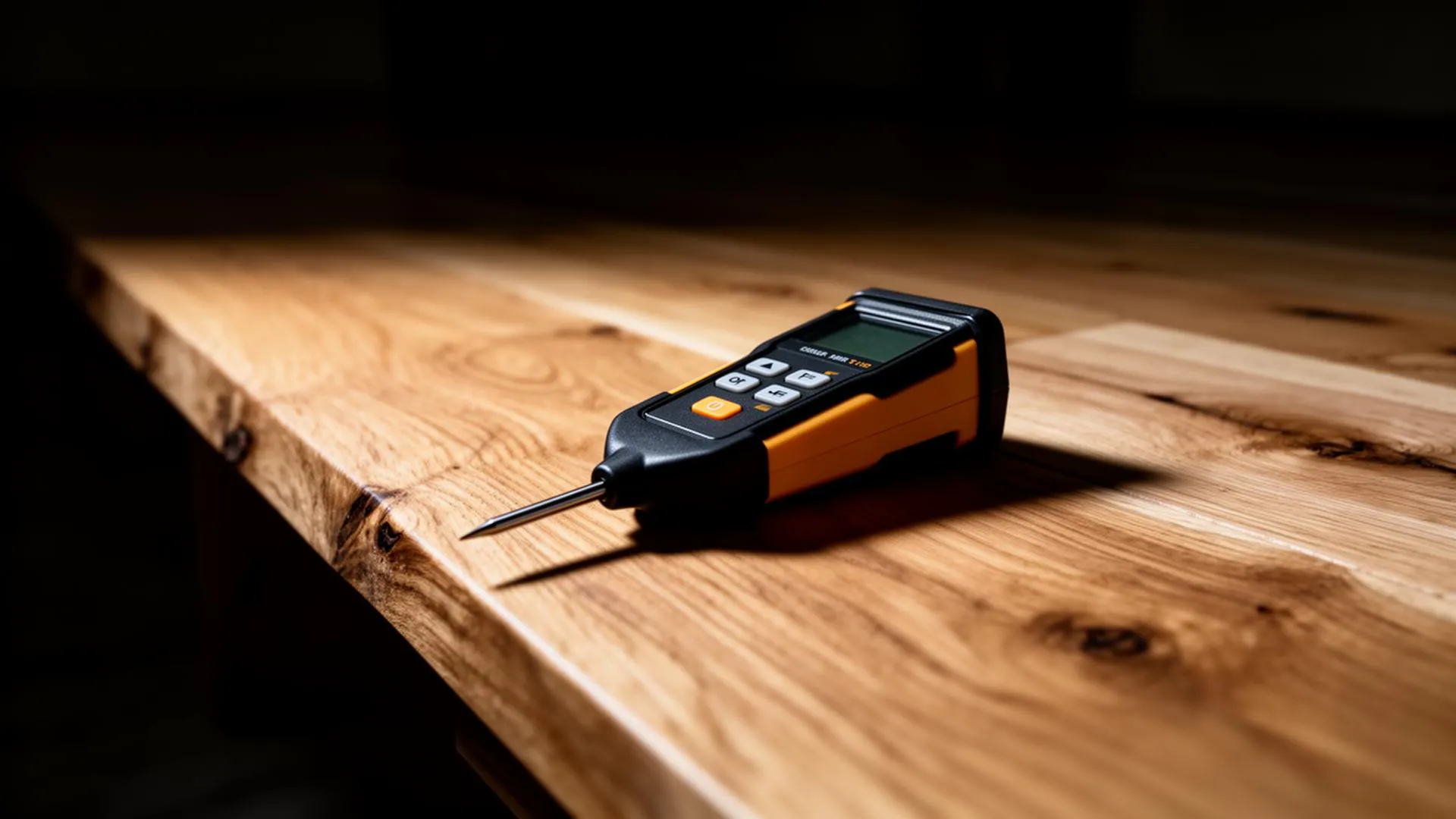
We use advanced NWFA protocols to measure the exact moisture difference between your new hardwood and your subfloor before a single plank is installed.
Strip Flooring (Under 3")
Strip Flooring Tolerances
For traditional strip floors measuring 3 inches or less in width, industry standards dictate that the moisture content of the hardwood must be strictly within 4% of the subfloor's moisture content before installation can safely begin.
Wide Plank Physics (Over 3")
Wide Plank Tolerances
The physics are simple: the larger the piece of wood, the greater its capacity to expand and contract. Wide planks demand significantly tighter moisture tolerances between the wood and the subfloor to prevent severe cupping and seasonal gapping.
The Specific Gravity Standard
Specific Gravity Calibration
Different wood species have different densities. Standard meters cannot tell the difference between White Oak and Brazilian Walnut. We utilize professional meters with specific gravity adjustments to calibrate for the exact species, and insulated pin meters to test internal core layers for scientifically flawless data.
Wood Science
Predicting the Physics of Your Floor.
Every floor behaves differently based on three distinct scientific factors.
The EMC Chart
Temperature + Humidity
We don't guess how your floor will react. By using an industry-standard Temperature and Humidity Chart, we can measure your home's current climate and accurately predict exactly what moisture percentage your wood will reach. This sets your entire project up for long-term success.
Dimensional Change Coefficient
Species Behavior
Not all woods are created equal. Different species shrink and swell at different rates when exposed to humidity a metric known as the Dimensional Change Coefficient. For example, Hickory will move significantly more than a highly stable species like White Oak.
Cut & Core Construction
Structural Engineering
How the lumber is cut (Quarter-Sawn vs. Plain-Sawn) and how the board is constructed (Solid vs. Engineered) dramatically alters how much the floor will expand or contract.
Read our Specification Guide →Climate Science
Controlling the Climate.
Michigan's humid summers and bone-dry winters will destroy a floor if your home's thermal envelope isn't managed. Your HVAC system is the life support for your hardwood.
Winter Shrinkage
Low Humidity
When the furnace runs all winter, it strips moisture from the air. The wood dries out, shrinks, and causes ugly gaps between planks. A whole-home humidifier is mandatory to maintain the NWFA-required 30 to 50% relative humidity.
Summer Expansion
High Humidity
During humid Michigan summers, wood absorbs moisture from the air and expands. If the air conditioning isn't controlling the indoor humidity, the planks will crush against each other, causing severe cupping and structural buckling.
The 'Always On' Rule
Climate Stability
Your home's HVAC system must be fully operational for at least 5 days before the wood is delivered, maintaining a temperature between 60 to 80°F. The environment must be controlled before, during, and for the entire life of the floor.
Heating Diagnostics
Diagnosing Your Heating System.
How your home is heated completely dictates your humidification strategy. Not all heating systems are equipped to protect a hardwood floor.
Radiant & Boiler Heat
No Ductwork Systems
Systems like in-floor radiant heat or traditional boiler radiators are incredibly efficient, but they lack forced ductwork. This means they have absolutely no built-in way to deliver humidity to the air. For these homes, we strongly recommend installing a separate, ducted steam humidification unit if architecture allows, or utilizing strategically placed, high-capacity portable humidifiers to maintain the required 30–50% RH.
Forced Air & Flow-Through Units
Ducted Systems
Standard furnaces often feature flow-through humidifiers. While efficient, the dial on these units is not a guarantee. Just because you set the dial to "40%" or "Winter" does not mean your home is actually holding that humidity. Variables like vaulted ceilings, drafty windows, and the overall insulation value of your thermal envelope drastically impact how much moisture is actually retained in the air.
Essential Equipment
Trust, But Verify: The Hygrometer.
You cannot manage what you do not measure. You must monitor your home's environment independently of your furnace settings. We advise every hardwood floor owner to invest in a quality digital hygrometer (an indoor humidity monitor). Placing these in the rooms with your hardwood allows you to verify that your HVAC system is actually capable of maintaining the correct environment for your floor.
Critical Warning
The #1 Cause of Winter Failures: The Vacation Rule.
When homeowners travel south for the winter or go on extended vacations, they often turn their thermostats down to save energy. Never turn off your climate control. Your hardwood floor is a living investment. You must maintain the exact same temperature and humidity environment as if you were actively living there. Dropping the temperature and turning off the humidifier while you are away is a guaranteed recipe for severe gapping, checking, and total warranty voidance.
Don't let your home's environment destroy your investment.
Contact our NWFA Certified Inspectors to measure your subfloor, evaluate your HVAC, and engineer a floor that will last a lifetime.
Related Services